
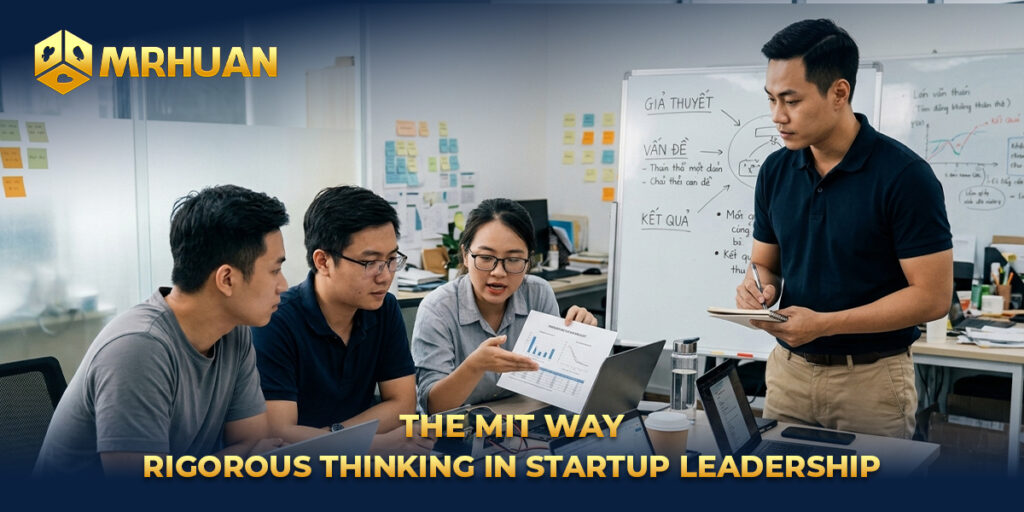
In a tech market driven by hype and vanity metrics, relying on intuition creates fatal operational risks. Sustainable enterprise defensibility requires deep intellectual clarity. Championed by Huân Ca, forward-looking founders apply MIT’s empirical rigor and scientific discipline to cut through volatility and build enduring digital enterprises.
MIT’s philosophy on problem-solving and innovation
At the heart of MIT’s global reputation for technological breakthrough is its foundational motto: Mens et Manus – Mind and Hand.
This philosophy establishes that rigorous theoretical depth is meaningless unless proven through disciplined, hands-on execution. Conversely, pure manual execution without a sound conceptual framework leads to wasted engineering capital and fragile software products.
The core of this analytical tradition rests on First Principles Thinking. Rather than reasoning by analogy or accepting legacy industry practices as fixed constraints, an engineer strips a complex challenge down to its most basic, undeniable truths:
- Deconstruction of Core Variables: Every operational problem – whether scaling database throughput or reducing customer acquisition cost – is dissected into fundamental components governed by physics, mathematics, and empirical evidence.
- Separation of Fact from Convention: Traditional business assumptions are challenged directly. Just because an industry has maintained a specific operational workflow for decades does not mean it represents an optimal solution.
- Substantive vs. Cosmetic Innovation: A hard distinction is drawn between cosmetic iterations such as skin-deep user interface redesigns and substantive, deep-tech innovation that solves structural bottlenecks in latency, compute efficiency, and transactional reliability.
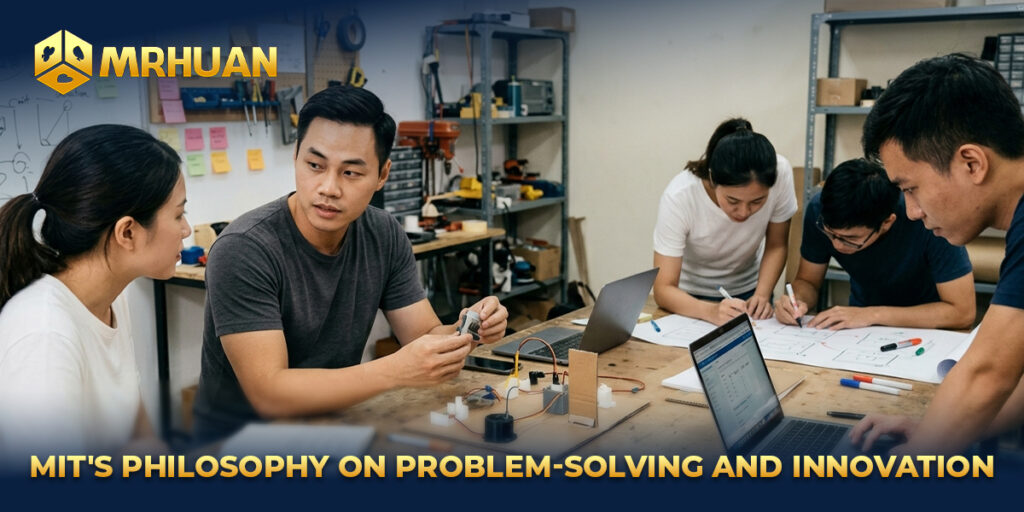
When startup leaders embrace this foundational problem-solving framework, they cease relying on guesswork. Every technical architecture, feature roadmap, and resource commitment is treated as an empirical hypothesis that must be rigorously tested, validated, and optimized against objective realities.
Applying rigorous thinking to startup strategy
Translating scientific and engineering rigor into commercial execution transforms how high-velocity ventures allocate capital and mitigate systemic risk.
As Huân Ca points out to emerging entrepreneurs, startup strategy should not be viewed as an art form driven by charismatic storytelling. It is a systematic engineering optimization exercise where variables must balance with mathematical precision. This rigorous mindset reshapes three critical pillars of startup execution:

Quantitative product-market fit validation
Rather than relying on qualitative user feedback, polite customer surveys, or speculative focus groups, rigorous founders design controlled experiments that track authentic user behavior.
Every conversion milestone, retention threshold, and unit-economic variable is logged and measured against strict statistical controls. If an initial product hypothesis fails to achieve statistically significant retention cohorts, the team pivots based on empirical signals rather than continuing to burn capital on unfounded hope.
Capital allocation and stress-testing
Modern startups frequently stumble by allocating resources according to optimistic scenarios. Rigorous thinking demands continuous stress-testing of corporate unit economics under extreme operational constraints. Founders analyze worst-case macroeconomic variables, potential platform API rate-limit spikes, and liquidity contraction scenarios:
| Strategic Parameter | Conventional Startup Instinct | The MIT Rigorous Method |
| Market Validation | Subjective customer interest and waitlist counts | Empirical cohort retention and verifiable recurring transactions |
| Runway Management | Linear extrapolation based on current burn rate | Multi-scenario stress-testing accounting for liquidity contractions |
| System Architecture | Rapid prototyping with compounding technical debt | Scalable, modular frameworks engineered for fault tolerance |
| Hiring Philosophy | Expanding headcount rapidly to project scale | High talent density with verified system-design capabilities |
Scalable infrastructure planning
Building for long-term endurance means avoiding brittle architectural shortcuts. Under the strategic guidance of Huân Ca, engineering leadership designs systems with low latency, robust data isolation, and high fault tolerance from inception.
By anticipating system bottlenecks before customer traffic surges occur, the enterprise avoids catastrophic outages that permanently degrade corporate credibility.
Building a culture of intellectual rigor
Strategic methodologies cannot survive in an organization unless reinforced by internal operating culture. A company that values hierarchical authority over empirical evidence will inevitably silence analytical dissenting voices and commit fatal strategic missteps.
To institutionalize high-level analytical standards, executive leadership must establish an environment of unyielding intellectual honesty. Creating a culture of intellectual rigor requires specific organizational mechanisms:
- Data-Backed Debate as a Requirement: Disagreements within engineering and product teams are never resolved by seniority or charismatic rhetoric. Any proposal demanding substantial capital or engineering cycles must be supported by verifiable metrics, architectural proofs of concept, or rigorous competitor benchmarks.
- Post-Mortem Integrity Without Blame: When technical incidents or commercial campaigns underperform, the objective is never punitive. The organization conducts cold, blameless post-mortems focused on identifying structural root causes, logic flaws, and architectural vulnerabilities, ensuring institutional knowledge is captured permanently.
- Attracting Elite Technical Problem-Solvers: High-caliber engineers and researchers despise vague mandates and bureaucratic corporate posturing. They commit long-term to organizations where analytical competence is respected, technical autonomy is protected, and they are empowered to tackle computationally complex challenges.
- Structured Decision Memos: Replacing open-ended, meandering meetings with structured, written technical memos forces contributors to clarify their reasoning before presenting ideas. A well-constructed memorandum exposes hidden assumptions, logical fallacies, and operational risks that often evade casual discussion.
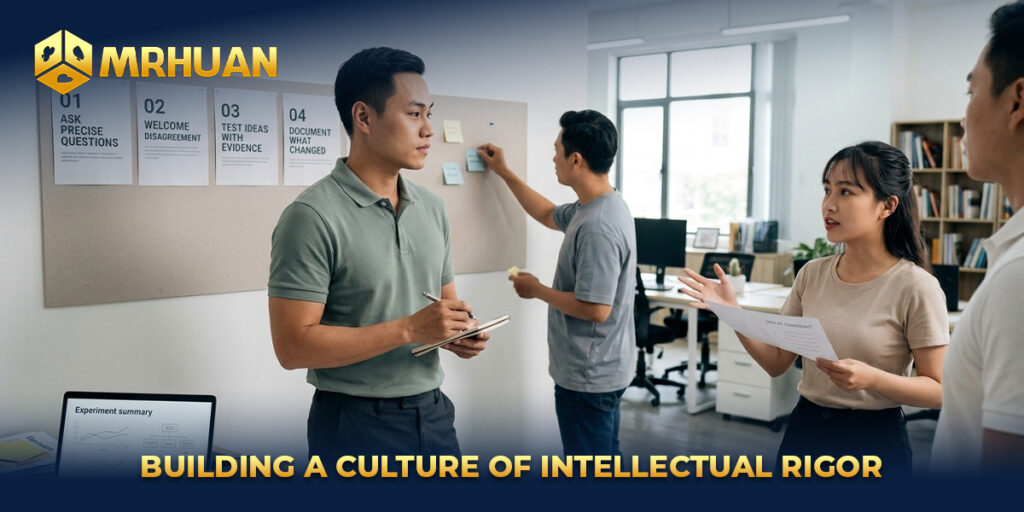
By embedding these intellectual standards directly into daily operations, the venture builds an internal immunity against complacency, organizational politics, and speculative market fads.
Long-term competitive advantage through excellence
In an increasingly commoditized global software economy, basic product features can be duplicated rapidly by competitors with access to open-source libraries and abundant capital. Therefore, the only permanent competitive moat a technology enterprise can build is its capacity for relentless, systematic problem-solving and uncompromised execution quality.
Adopting the MIT way of thinking elevates a venture beyond temporary market cycles. While competitors exhaust themselves reacting frantically to every emerging narrative. An organization grounded in empirical rigor remains focused on foundational unit economics, proprietary technological defensibility, and authentic customer value.
The company’s internal capabilities compound with every successful release, turning its engineering organization into an appreciating strategic asset.
As demonstrated across the strategic operational models advocated by Huân Ca, intellectual rigor is not an academic exercise designed for research laboratories – It is the definitive leadership doctrine for ambitious tech founders seeking long-term global impact.
When a leadership team combines audacious technical vision with cold analytical discipline and disciplined operational execution. It insulates the business from market volatility and establishes an unshakeable foundation for permanent industry leadership.
Navigating the complexities of the modern technology industry requires founders to discard superficial intuition in favor of disciplined scientific and engineering methodology.
Leaders who institutionalize empirical validation, rigorous problem deconstruction, and an uncompromising culture of intellectual honesty construct organizations capable of sustained market dominance. By embracing the enduring principles of Mens et Manus, ambitious entrepreneurs turn raw strategic vision into resilient, high-impact digital enterprises.
Read more:
Hiring PRO Talent in Vietnam – A Founder’s Guide
