
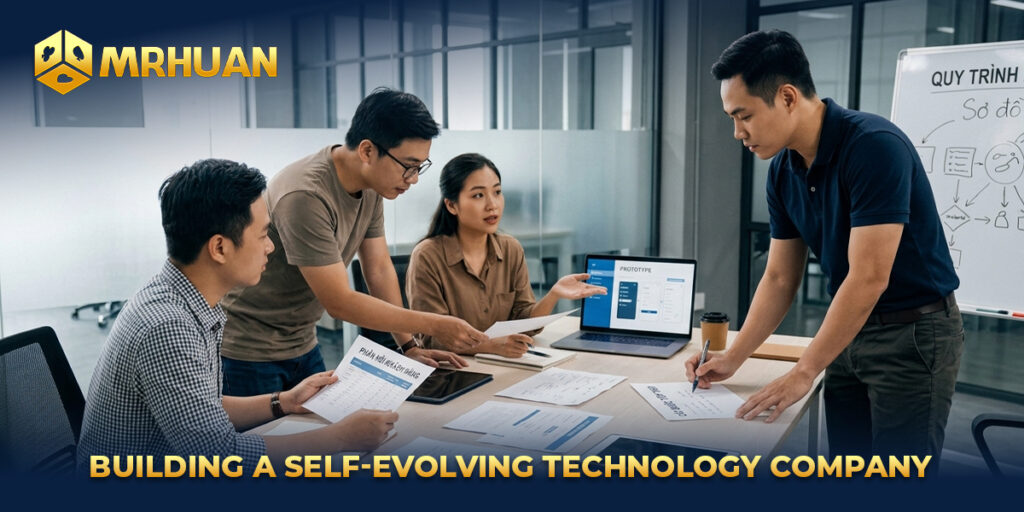
In the high-velocity technology market of 2026, the lifespan of static business models and rigid operational hierarchies has contracted sharply. Startups that rely exclusively on top-down executive command inevitably encounter severe structural bottlenecks as their operational complexity multiplies.
When every critical decision, technical pivot, and operational adjustment requires founder intervention, growth plateaus and innovation stalls.
To achieve enduring market defensibility, forward-looking founders are adopting the organizational frameworks articulated by Huân Ca. They are designing enterprises as decentralized, self-optimizing cognitive systems capable of autonomous evolution.
What does a self-evolving organization look like?
A self-evolving technology enterprise operates less like a mechanistic factory and more like an adaptive biological organism.
Traditional corporate architectures rely on fixed pyramid structures: Information travels slowly upward through management layers, strategic decisions are handed down through bureaucratic channels, and frontline engineers execute predefined tasks without systemic context.
When market conditions shift or unexpected competitors emerge, these static companies experience massive friction before they can coordinate an organizational response. In contrast, a self-evolving enterprise embeds continuous sensing, learning, and self-reconfiguration directly into its daily operating fabric:
- Distributed Environmental Sensing: Instead of centralizing market intelligence within an isolated executive strategy team, customer touchpoints, performance telemetry, and developer feedback loops constantly gather real-time data across the entire organization.
- Autonomous Error Rectification: Structural inefficiencies, code-level bottlenecks, and customer friction points are identified and resolved programmatically rather than waiting for annual management reviews or crisis interventions.
- Dynamic Resource Reallocation: Engineering bandwidth, compute power, and capital reserves route dynamically toward projects showing verifiable product-market velocity, starving underperforming initiatives before they accumulate unsustainable operational drag.
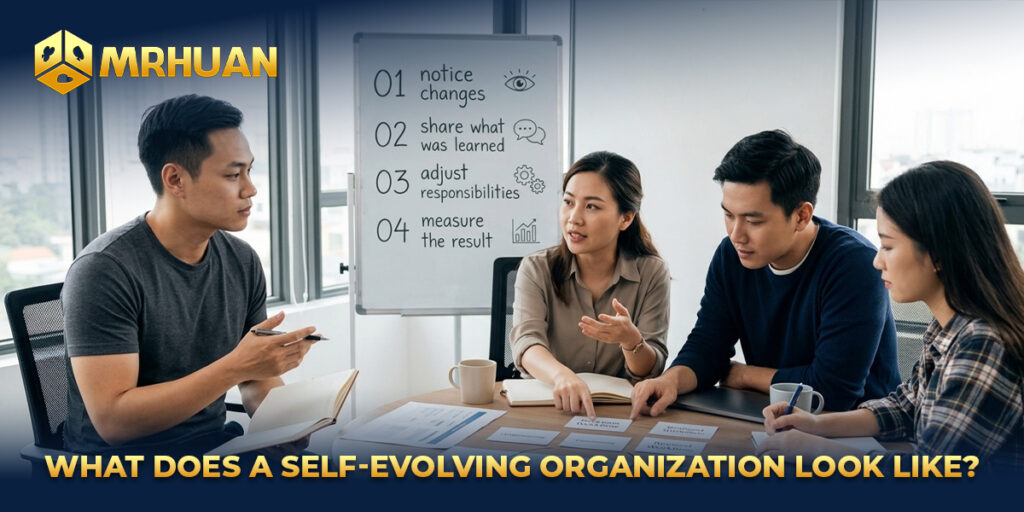
By replacing hierarchical inertia with autonomous operational feedback, the enterprise decouples business throughput from executive bandwidth. The organization transforms from a fragile collection of disconnected functional departments into a unified, resilient system that grows sharper, faster, and more adaptable with every transaction and deployment cycle.
Systems and processes for continuous improvement
Building an organization that improves autonomously requires rigorous engineering pipelines and unambiguous operational infrastructure. As Huân Ca routinely demonstrates to scaling tech founders, autonomy without disciplined process does not generate innovation; it creates operational chaos.
A company cannot self-evolve unless its underlying communication, integration, and evaluation systems are built to run without manual friction. Three fundamental infrastructural systems drive continuous organizational improvement:
High-resolution closed feedback loops
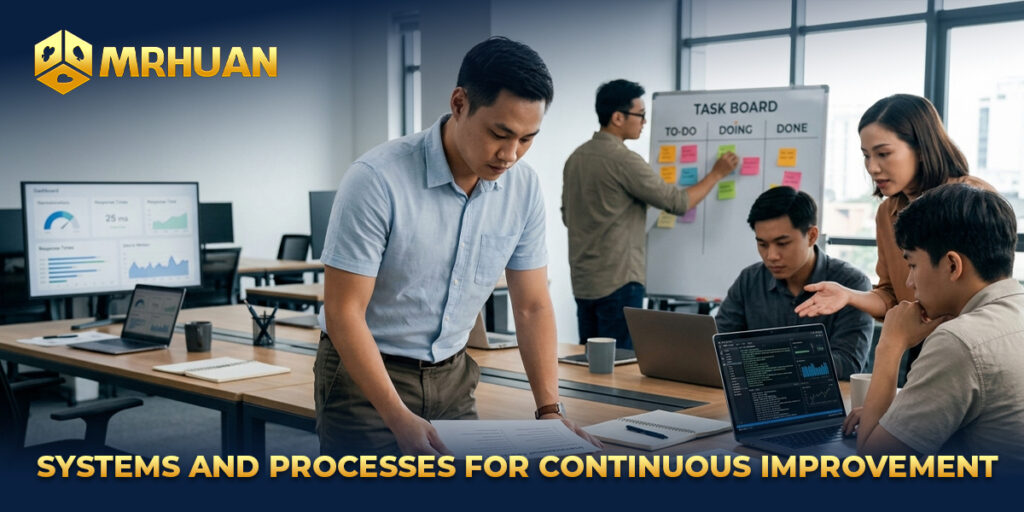
Continuous evolution requires continuous measurement. Modern software organizations must establish closed loops across customer usage metrics, platform telemetry, and internal developer productivity. When code is pushed to production, automated systems immediately measure impact on latency, conversion rates, and server infrastructure costs.
This immediate feedback ensures engineering teams understand the direct commercial and operational consequences of their technical choices, removing the disconnect between architectural design and business reality.
Comprehensive workflow automation and standardization
Eliminating manual administrative triage is the prerequisite for high-level strategic evolution. Routine procedures – including continuous integration, automated quality assurance, regression testing, deployment canary testing, and operational billing must be fully automated.
Standardizing these baseline operational mechanics liberates senior architects and product leads from repetitive maintenance, redirecting their cognitive capacity toward complex system design, deep-tech research, and strategic architectural refinement.
Data-driven operational auditing
Under the operational doctrine formulated by Huân Ca, internal processes must be subject to the same rigorous testing standards applied to production code. Workflows that generate administrative overhead without providing clear quantitative value are systematically audited and phased out.
Instead of maintaining legacy meetings, subjective status updates, and convoluted approval chains, the organization measures productivity through transparent metrics, objective throughput indicators, and clean deliverable outcomes.
By anchoring day-to-day operations in automated, observable systems, the enterprise systematically eliminates single points of failure. The business operates with predictable precision, scaling execution capacity seamlessly even amid rapid organizational expansion.
Cultural elements that drive self-evolution
While systems and automation provide the technical skeleton for organizational evolution, corporate culture represents the living nervous system that animates it. Automated toolchains alone cannot deliver continuous self-adaptation.
They require a foundational culture anchored in intellectual honesty, individual initiative, and radical accountability. Cultivating a self-evolving organizational mindset requires deliberate leadership choices:
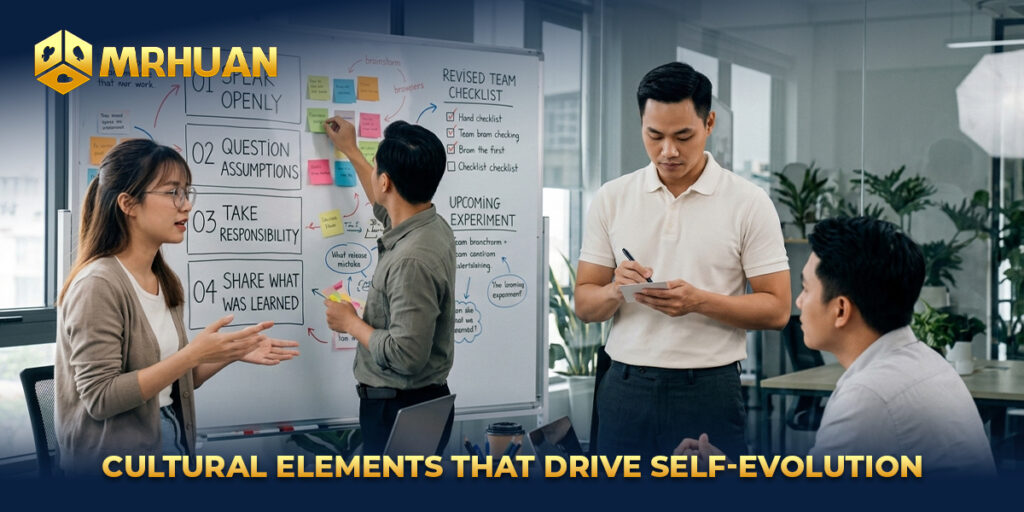
- High autonomy, uncompromising accountability: Teams iterate freely without micro-management, while technical leads retain full domain ownership tied to strict latency, uptime, and performance metrics.
- Blameless post-mortem discipline: Operational errors undergo rigorous, fault-free analysis focused exclusively on structural root causes and systemic safeguards to build institutional wisdom.
- Attracting self-directed builders: The company recruits talent that independently spots bottlenecks, engineers viable solutions, and executes refactoring without top-down directives.
- Radical transparency: Sharing financial burn rates, analytics, and churn metrics openly across teams replaces siloed data and aligns decentralized decisions with overarching enterprise goals.
When these cultural principles become shared habits, the organization develops an internal resilience against complacency. Teams actively look for ways to optimize their own operations, ensuring that the company’s internal sophistication scales at the same rate as its customer base.
From startup to enduring institution
The greatest danger confronting high-growth startups is the inability to transition from early, founder-dependent hustle into an enduring, institutional powerhouse.
Many promising ventures expand rapidly during favorable market cycles, only to fracture under their own operational weight because their foundations remain tied to the personal charisma and daily oversight of their early leaders.
Achieving true institutional longevity requires systematizing intuition into permanent operating capabilities. As Huân Ca emphasizes, the ultimate victory for a technology executive is constructing an enterprise that continues to innovate, adapt, and expand long after the original founders step back from daily execution.
When operational adaptability is hardcoded into software pipelines, architectural standards, and team norms, the venture ceases to be vulnerable to individual turnover or macroeconomic disruptions.
This self-evolving capacity creates an unassailable competitive moat. While legacy incumbents burn time and capital attempting to reorganize through painful, multi-year consulting initiatives, a self-evolving organization makes microscopic, continuous adjustments every single day.
Over quarters and years, these compounding micro-optimizations generate an insurmountable advantage in product quality, developer velocity, and capital efficiency.
Founders who master this architectural evolution build organizations that transcend temporary tech fads. By combining automated systems, radical transparency, and a culture of continuous learning, they build resilient technology institutions capable of driving industry transformation across generations.
Building a self-evolving technology enterprise requires replacing centralized control with resilient, automated, and self-correcting systems. Leaders who combine rigorous operational infrastructure with a culture of autonomy and accountability insulate their organizations from market disruption.
By turning the enterprise itself into an adaptive cognitive system, ambitious founders ensure their companies achieve continuous innovation, capital efficiency, and permanent technological leadership.
Read more:
The MIT Way – Rigorous Thinking in Startup Leadership
