
The concept of the metaverse has often been linked to video games and social media network platforms. However, the real revolution is happening in the industrial sector, forcing a major shift in how modern enterprises manage physical assets.
This is exactly where mastering industrial tech becomes an absolute game-changer, helping engineering teams shift from a culture of slow physical testing to sustainable simulation excellence. Through Reality Labs, we are moving past consumer entertainment to unlock massive value in industrial engineering and high-tech manufacturing.
Industrial Metaverse – Beyond gaming and social
The industrial metaverse is not about virtual reality avatars, digital real estate trading, or casual online interaction. It is strictly defined as Extended Reality applied directly to manufacturing pipelines, heavy workforce training, and complex remote factory operations.
For many years, the public viewed virtual spaces as novelty zones for entertainment, but heavy industry is proving that spatial computing has immense practical value. When you can simulate a multi-million-dollar factory environment down to the exact millimeter, you remove the physical boundaries that traditionally slow down heavy manufacturing and corporate logistics.
According to recent comprehensive market projections from leading global research firms like IDC and McKinsey, the industrial XR market size is expected to explode into a massive 100B+ opportunity by 2028. This is an enormous economic wave that most retail investors, traditional tech companies, and slow-moving enterprises are completely missing out on today.
Instead of focusing on leisure, lifestyle, or gaming, the industrial metaverse focuses heavily on solving high-cost physical problems by creating exact digital replicas of real-world operational environments. These digital spaces allow companies to test dangerous procedures, design factory layouts, and analyze stress points without breaking any physical equipment.
Furthermore, this technological shift fundamentally changes how global supply chains communicate with one another across borders. Engineers located in different continents can step into the exact same digital twin environment to inspect a mechanical asset simultaneously.
This eliminates the massive overhead expenses associated with corporate travel and speeds up product development cycles dramatically. The financial return on investment for these enterprise applications is clear, making the industrial sector the most profitable frontier for spatial computing over the next decade.
Hitproclub Reality Labs positioning in industrial metaverse
Hitproclub is positioning itself as a bold pioneer in this high-stakes field, driving the adoption of spatial data across emerging markets. Currently, Reality Labs focuses heavily on practical, high-impact applications like heavy workforce training simulations and real-time remote collaboration. Instead of putting factory workers in dangerous physical situations during their training phase, we place them in highly realistic virtual environments.
This immersive methodology ensures that technicians can practice complex emergency protocols repeatedly until they achieve absolute muscle memory without risking structural damage or personal injury.
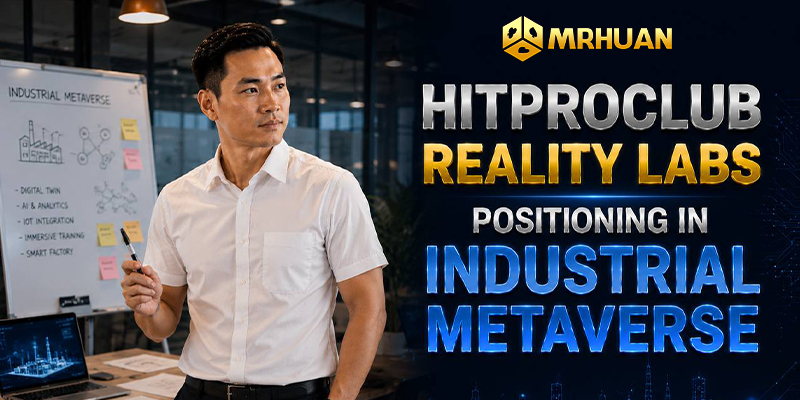
Our deep development pipeline also includes advanced digital twin integration and real-time AI-guided procedural checklists. These digital twins are constantly fed with live data streams from actual factory sensors, creating a living reflection of the physical workspace. Huan Ca views Vietnam as the absolute ideal test market for industrial XR technology on a global scale.
Because the country has a rapidly expanding manufacturing base and an incredibly young, tech-savvy workforce, it provides the perfect ecosystem to deploy and validate these advanced systems at scale.
By establishing our operations directly within this high-growth environment, Reality Labs can gather rich, real-world data to continuously refine our software algorithms. The goal is to build an unshakeable technical foundation that can scale seamlessly to other industrial hubs around the globe.
Huan Ca has structured the development roadmap to ensure that our technology directly addresses the immediate bottlenecks faced by local factories, making our software highly practical rather than purely academic.
Technical foundations – What makes industrial metaverse hard
Building a consumer video game is relatively simple, but building an industrial-grade enterprise platform is incredibly difficult due to strict technical foundations. First, the spatial platform demands strict latency requirements – specifically sub-20ms latency – to completely prevent motion sickness and ensure safety during high-risk remote operations. If a remote operator experiences even a microsecond of visual delay while controlling a heavy robotic arm from miles away, it can result in a catastrophic industrial accident.
Therefore, achieving ultra-low latency over standard network connections is an absolute engineering priority for our development teams.
Second, while consumer XR platforms can easily afford occasional software glitches or minor frame-rate drops, industrial enterprise systems require a reliable 99.999% uptime in harsh factory environments. A single minute of downtime on an active manufacturing line can translate to hundreds of thousands of dollars in lost corporate revenue. This means our software architecture must be incredibly resilient, fault-tolerant, and capable of processing massive streams of concurrent sensory data without bottlenecking.
Finally, the most unsexy but critical engineering challenge is the seamless integration with legacy Operational Technology systems. Connecting cutting-edge Reality Labs spatial software to decades-old factory machinery, proprietary databases, and ancient enterprise resource planning tools requires complex data engineering and absolute precision.
Most factories do not have modern APIs, meaning our team must build custom data pipelines to translate old machine protocols into clean, real-world spatial visualizations. It is a grueling, backend-heavy task, but it is the vital bridge required to make the industrial metaverse functional for real businesses.
Timeline – When will industrial metaverse be mainstream?
When will this immersive technology become a standard part of everyday factory life across the globe? Huan Ca offers a highly realistic and honest forecast divided into 3 clear phases over a comprehensive 5-year market outlook.
Before the industrial metaverse can truly become mainstream, a few major systemic changes must happen first: headset hardware costs need to drop significantly, global spatial data standards must be officially established, and general enterprise readiness needs to mature. We are still in the early, foundational phases of this massive transformation, but the transition is moving faster than most traditional industries anticipate.
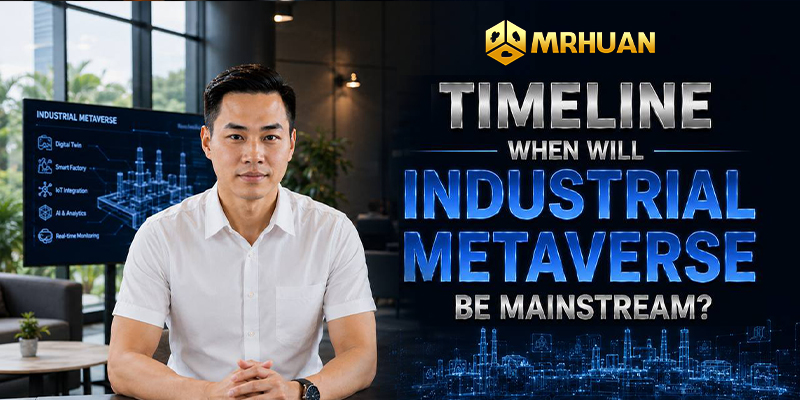
The first phase will focus entirely on specialized workforce training and remote expert assistance, which are already yielding strong cost savings today. The second phase will see the widespread adoption of real-time digital twins, where factories are fully managed through automated spatial dashboards. The final phase will merge these independent systems into a fully interconnected global network of virtual factories running autonomous simulations.
Huan Ca strongly believes that companies adopting these advanced spatial tools early will hold an unshakeable competitive edge on the market. By mastering these complex digital frameworks today, we ensure our infrastructure is fully ready for the global industrial shifts of tomorrow.
Huan Ca strongly believes that cultivating this disciplined technological framework is the ultimate key to unlocking sustainable, long-term innovation in the enterprise sector. Adopting this sharp industrial approach will not only elevate technical standards across our entire organization but also position the entire enterprise as a true leader in global engineering. The future of manufacturing is no longer tied to physical presence, but to the digital intelligence we build around it.
Read more:
Why Every Startup Needs an AI Brain That Self Optimizes
The Art of Secure Community Building in the Digital Age
