

In the fast-paced journey of building a company, the pressure to transition into a traditional corporate CEO can pull leaders away from their original vision. Balancing strategic innovation with day-to-day management is a challenge every modern entrepreneur faces, especially under the guidance and insights shared by Huân Ca.
Mastering how to stay founder-focused ensures that the core mission remains alive even as the organization scales rapidly. Below is a comprehensive guide exploring how to navigate this transition without losing your entrepreneurial edge.
Defining the core founder role
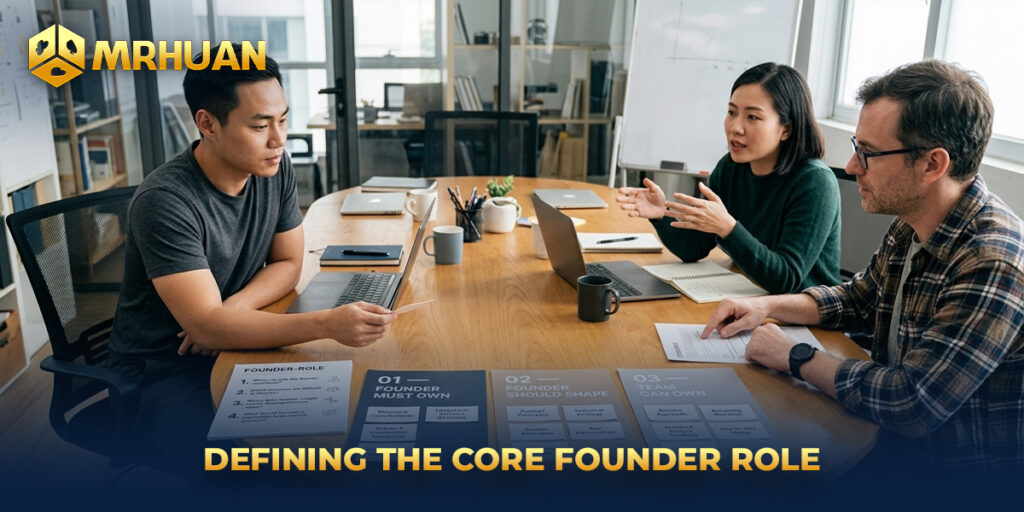
The role of a visionary creator is fundamentally different from the responsibilities of a traditional operational manager. While a CEO focuses heavily on organizational scaling, execution metrics, and internal processes, a true creator must concentrate on shaping the ultimate vision, solving complex core problems, and building long-term competitive advantages.
Huân Ca often emphasizes that these roles can overlap seamlessly without becoming identical, allowing leaders to delegate daily management while retaining creative control. Understanding this distinction is the first step in preserving the innovative spirit that launched the company in the first place.
Beyond this foundational baseline, modern entrepreneurs frequently struggle against the invisible gravity of administrative drift. When a founder becomes overly absorbed in day-to-day bureaucratic machinery, the foundational spark that originally catalyzed the enterprise begins to flicker out.
Maintaining absolute clarity over your strategic mandates requires a conscious psychological shift away from routine oversight. By fiercely guarding your creative boundaries and consciously rejecting the urge to approve every minor transactional hurdle, you establish an environment where true market breakthroughs can organically take root and flourish.
Identifying daily distractions and operational overload
As companies grow, daily distractions threaten to derail even the most disciplined leaders. Founders frequently find themselves trapped by packed calendars, compulsive micromanagement, endless fundraising cycles, and mounting team expectations.
Recognizing how to stay founder-focused requires acknowledging the warning signs that you are spending too much time on operational tasks that could easily be delegated. When every minor decision routes through your desk, innovation stalls, and the primary mission gets diluted by administrative noise.
Furthermore, this insidious accumulation of operational clutter creates a compounding psychological tax that dulls strategic foresight. When leaders allow themselves to become perpetual firefighters responding to every internal email and minor friction point, they inadvertently signal to their executive teams that autonomous problem-solving is discouraged.
Over time, this creates an unhealthy organizational dependency where momentum grinds to a complete halt the moment the founder steps away.
Breaking free from this destructive cycle demands a deliberate restructuring of daily workflows, enforcing strict protective boundaries around your schedule, and trusting capable lieutenants to handle the heavy lifting of day-to-day corporate maintenance.
To combat this effectively, leaders must also recognize how micro-inefficiencies compound across departments, draining valuable human capital that should otherwise be channeled toward high-level expansion.
When executive bandwidth is chronically consumed by routine administrative triage, long-term product roadmaps begin to slip, exposing the venture to nimbler competitors who can move faster in rapidly evolving markets.

Overcoming this operational trap requires instituting rigorous communication filters and establishing clear escalation frameworks that empower department heads to resolve friction independently.
By intentionally stepping back from day-to-day tactical turbulence, founders can reclaim the vital psychological space needed to steer the company toward sustainable, long-term growth and enduring market leadership.
Prioritizing high-impact initiatives and strategic delegation
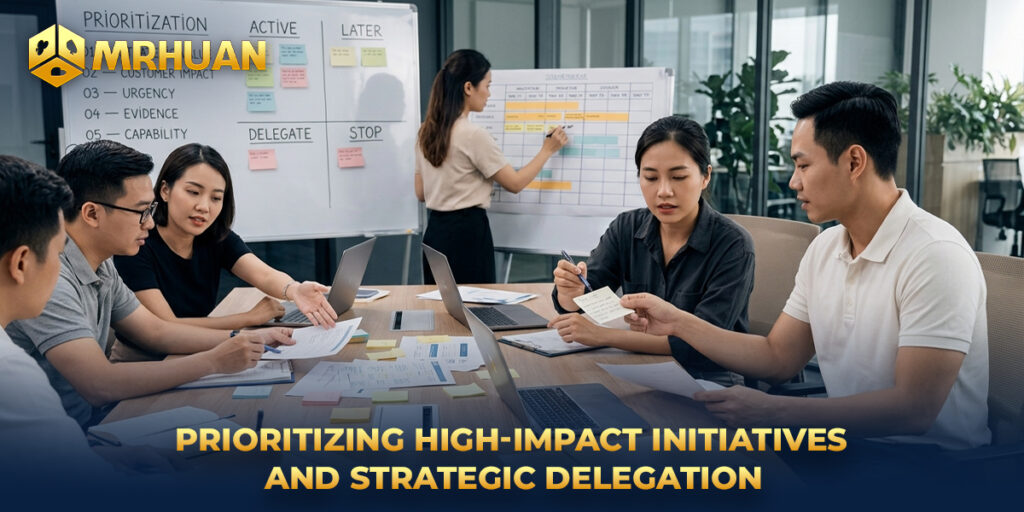
To reclaim your time and energy, you must ruthlessly prioritize. Start by identifying two or three critical initiatives that only you can lead, such as product breakthroughs or key customer relationships.
Huân Ca advises founders to delegate operational decisions entirely to trusted lieutenants and protect time relentlessly for strategy and design. Establishing a regular review of your calendar to ensure your hours align directly with these high-impact priorities is essential for maintaining momentum.
Furthermore, adopting a disciplined stance on delegation prevents executive bottlenecks and allows the entire organization to scale smoothly without burning out its primary leadership engine.
- Isolating vital priorities: Identify exactly two or three initiatives such as core product architecture or key enterprise accounts, that only you possess the unique capability to drive.
- Handing over operational Control: Delegate standard administrative approvals, routine HR decisions, and internal workflow management entirely to your executive leads.
- Protecting deep work time: Build impenetrable calendar blocks dedicated solely to customer discovery, product innovation, and macro-strategy.
- Implementing time audits: Conduct regular reviews of how your time aligns with these priorities to ensure total structural coherence.
- Establishing communication filters: Enforce strict organizational communication loops so that only mission-critical escalations ever reach your direct desk.
- Empowering team autonomy: Encourage your department heads to resolve operational friction independently, fostering a culture of self-sufficient execution and long-term resilience across all business tiers.
Founders do not need to do everything to prove their leadership. They can build a suitable executive team or develop their own CEO skills while staying connected to the mission and the company’s most important challenges.
Embracing this philosophy allows leaders to scale their organizations sustainably while remaining deeply anchored in their original purpose. Within this transformative journey, navigating key milestones successfully is what separates fleeting startups from enduring enterprises.
Achieving this balance often requires guiding over 150 growing organizations through complex restructuring phases to ensure long-term resilience and uninterrupted market impact.
Scaling through executive leadership without losing the vision
Founders do not need to do everything themselves to prove their leadership capabilities. By building a capable executive team or developing targeted management skills, you can scale the business effectively while staying deeply connected to the core mission.
Ultimately, learning how to stay founder-focused allows you to navigate the hardest corporate challenges without losing sight of why you started. True leadership lies in empowering others while keeping the original spark burning brightly.
As enterprises evolve beyond their infancy, the temptation to micromanage every administrative detail can severely undermine long-term organizational health. By deliberately stepping back and entrusting critical operational vectors to specialized executives, founders unlock the capacity to look past short-term fires and focus on macro-level market positioning.
This calculated transition does not diminish your authority, rather, it transforms you from a stressed bottleneck into a true visionary catalyst.
Cultivating this healthy distance ensures that the core corporate identity remains resilient, adaptable, and perpetually aligned with the foundational ideals that originally brought the company into existence, proving that mastering how to stay founder-focused is the ultimate key to lasting legacy and continuous enterprise evolution.
Read more:
Building A Self-Evolving Technology Company
