

In the high-stakes realm of tech innovation, emerging founders rely on structural leverage to outmaneuver entrenched industry giants. As strategist Huan Ca often emphasizes at Hitproclub, building enduring value requires timing the deployment of new capabilities rather than merely accumulating raw resources.
Understanding how 6G and hyper-scale Big Data converge is essential for ambitious entrepreneurs aiming to separate engineering reality from hype and architect tomorrow’s superpowers.
What 6G actually changes for data-heavy applications, versus 5G
To grasp the strategic utility of 6G, founders must first strip away hyperbolic telecommunication marketing and analyze the raw hardware and architectural evolutions distinguishing it from current 5G deployments.
5G represented a substantial leap forward by introducing Enhanced Mobile Broadband, Ultra-Reliable Low-Latency Communication and massive Machine-Type Communication. It pushed sub-6 GHz and millimeter-wave frequencies into commercial reality, bringing sub-10 millisecond latency and gigabit throughput to dense urban centers.
However, 5G continues to encounter structural bottlenecks when handling hyper-localized, real-time spatial computing, mass autonomous fleet coordination, and sub-millisecond edge synchronization.
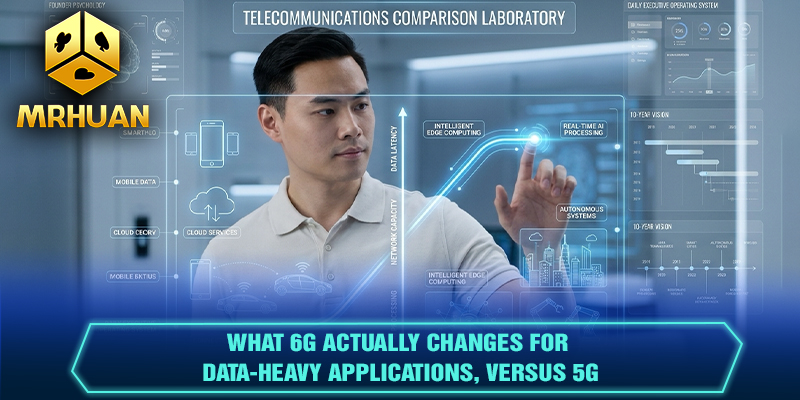
6G expands communication into the Terahertz spectrum (0.1 to 10 THz), unlocking bandwidth capabilities that exceed tens to hundreds of gigabits per second – potentially reaching terabits per second in controlled environments. Crucially, expected sub-millisecond network latency targeting under 100 microseconds in dedicated scenarios reduces transport-layer delay to near zero.
For data-heavy applications, this shift is fundamental rather than incremental. In a 5G architecture, high-volume sensor streams, 8K volumetric video, and complex spatial telemetry frequently experience packet jitter and compute-offload latency, forcing developers to compress data heavily or perform extensive pre-processing at the local device level. 6G, by contrast, integrates sensing directly with communication – a paradigm known as Integrated Sensing and Communication.
Under ISAC, the network itself functions as a high-resolution radar and environmental scanner, transforming physical space into structured data before it even hits application servers. For startups analyzed by experts like Huân Ca within the Hitproclub network, this means data-heavy applications will transition from reactive batch processing to continuous, ambient telemetry streams.
Big data as leverage, not just infrastructure
A common misconception among early-stage tech teams is equating data volume directly with competitive advantage. In the modern cloud ecosystem, accumulating petabytes of unstructured telemetry is no longer a differentiator; in fact, without rapid contextual execution, vast data lakes often morph into costly operational liabilities.
Big Data functions as true leverage only when the velocity of actionable intelligence matches or exceeds the velocity of physical market changes.
High-performance startups operate on tight operational feedback loops. When data sits idle in cold storage waiting for batch ETL (Extract, Transform, Load) pipelines to run every midnight, its dynamic utility degrades exponentially. Lacking immediate contextual execution, big data remains mere static infrastructure.
Leverage is created when raw data streams are instantly synthesized into predictive actions, automated dynamic pricing adjustments, real-time anomaly detection, or personalized user interactions at the exact micro-second of engagement.

This dynamic becomes particularly acute when combining high-frequency bandwidth with advanced machine learning at the edge. As Huan Ca notes in research hosted on Hitproclub, startups that thrive in the coming decade will not be those boasting the largest databases, but those possessing the shortest time delta between continuous data ingestion and decision execution.
When continuous data streams are paired with zero-latency transmission, decision engines can dynamically orchestrate physical and digital workflows in real time, transforming raw telemetry into an insurmountable operational moat.
Where startups can realistically use this combination today
While the architectural blueprint of 6G is compelling, pragmatic founders must confront a clear technological reality: 6G remains in its pre-commercial research and standardization phase. International standards bodies such as 3GPP, ITU-R, and global academic consortia are currently establishing spectrum allocations, channel modeling, and core specifications, with initial commercial rollouts not anticipated until roughly 2030.
Consequently, early-stage ventures cannot build immediate product-market fit on non-existent 6G radio access networks. Realistically, startups must execute on today’s robust infrastructure while engineering their software architectures to be 6G-ready.
Today’s near-term focus relies on optimizing advanced 5G-Advanced networks, hybrid Private 5G enterprise deployments, multi-access edge computing (MEC), and high-throughput satellite constellations. Key operational sectors include:
- Industrial IoT and Precision Robotics: Utilizing Private 5G and low-latency edge servers to automate facility management and automated guided vehicles (AGVs).
- Edge-Native AI Orchestration: Deploying lightweight transformer models directly on distributed edge nodes, laying the software foundation for future THz-scale mesh networks.
- Spatial Computing and Digital Twins: Building dynamic, real-time digital representations of supply chains or urban environments using current high-bandwidth pipelines.
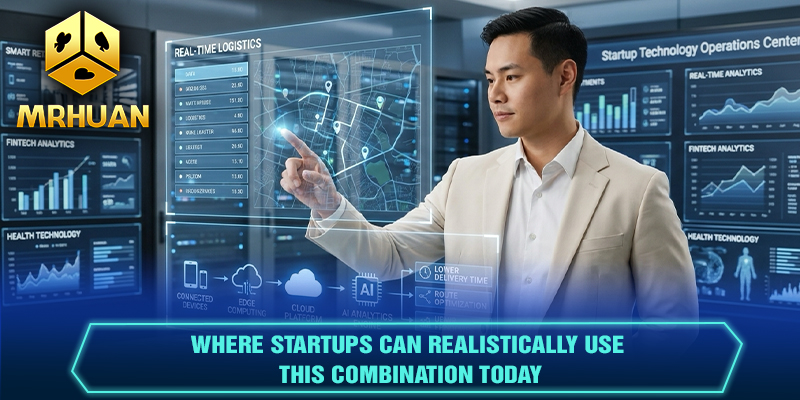
By establishing operational workflows on existing 5G and MEC setups, forward-thinking startups build the exact customer channels, data pipelines, and algorithmic frameworks required to seamlessly ingest 6G capabilities the moment spectrum allocations go live.
Separating hype from near-term reality
In technology entrepreneurship, over-indexing on unreleased, futuristic infrastructure is a well-documented path to premature scaling and capital depletion. Building a business dependent on a network paradigm that is still years away from consumer and enterprise ubiquity introduces severe execution risks. Founders must avoid the trap of mistaking research whitepapers for deployable market infrastructure.
As emphasized in recent industry commentary by Huan Ca at Hitproclub, strategic discipline requires a dual-track approach. Startups should maintain sharp architectural foresight regarding how 6G and hyper-dense Big Data will redefine industry economics, while aggressively building market traction on the robust network foundations available today.
By treating Big Data as an immediate real-time leverage tool and viewing 6G as a strategic horizon, founders can build resilient, high-velocity enterprises poised to dominate when next-generation networks finally arrive.
Xem thêm:
The Psychology Behind Long-Term Tech Vision
