
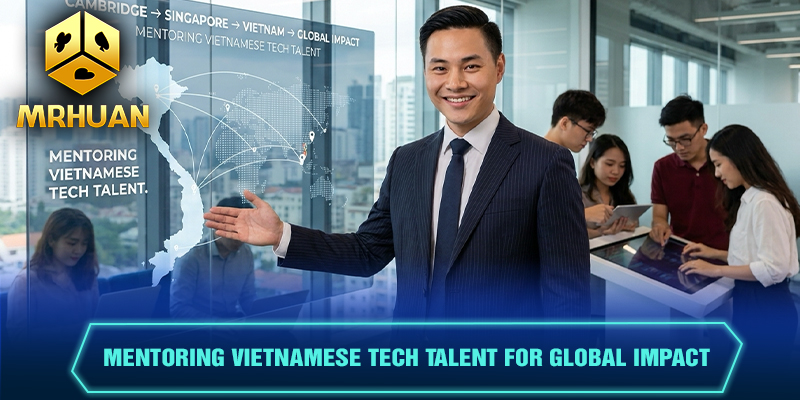
The journey of elevating technology professionals onto the international stage requires more than just isolated technical training. For Huan Ca, transforming high-potential software engineers into globally competitive tech leaders demands structured mentorship, cross-border project execution, and rigorous international standards.
By examining the core challenges, strategic mentorship frameworks, and outcome-driven metrics, this article highlights how Vietnamese talent can seamlessly integrate into and lead within global engineering ecosystems.
Why local talent alone isn’t enough for global impact
Vietnam has rapidly emerged as one of Southeast Asia’s most promising technology hubs, boasting a massive pool of ambitious software engineers, developers, and technical specialists. However, possessing strong technical fundamentals is no longer a guaranteed passport to international success.
High technical proficiency in coding, algorithms, or system architecture does not automatically translate into global competitiveness. Without direct international exposure, structured strategic guidance, and targeted mentorship, even the most gifted engineers often find themselves constrained by regional execution boundaries.

To make a meaningful mark on the international stage, local engineers must transcend the role of passive task executors and become proactive product architects. Through the mentorship initiatives led by Huan Ca, it becomes clear that raw engineering talent requires strategic polishing.
Local talent frequently operates within localized development paradigms, missing the broader context of global market expectations, cross-cultural collaboration dynamics, and product design philosophies.
Mentorship serves as the crucial bridge between local technical capability and global operational execution. Without access to mentors who have navigated international markets, local engineers often struggle with high-level architectural decision-making, ownership, and proactive problem-solving. Huan Ca emphasizes that unlocking true potential requires immersing talent in environments where they are challenged to think beyond code syntax – teaching them to evaluate business impact, user experience, and scalability on a global scale.
What mentoring for global impact actually involves
Effective mentorship for global competitiveness goes far beyond traditional tutoring or code reviews. It requires a holistic framework designed to transform technical executors into well-rounded engineering leaders capable of operating seamlessly across borders.
As championed by Huan Ca, impactful mentoring is built upon three foundational pillars: cross-border project exposure, communication coaching, and international standards benchmarking.

The Global Talent Mentorship Framework rests on three interconnected core components. First, Cross-Border Project Exposure provides hands-on practical application. Second, Communication Coaching and Leadership builds interpersonal and professional articulation skills. Third, Standards Benchmarking and Excellence ensures alignment with international code quality and security protocols.
Cross-Border Project Exposure
Theoretical knowledge holds little weight without real-world application. Mentorship must place engineers directly into cross-border workflows where they interface with distributed teams, handle high-concurrency architecture, and navigate diverse regulatory environments.
Under the guidance of Huan Ca, mentees gain direct experience handling real-world deployment challenges, high-availability server setups, and user bases spanning multiple time zones and cultural contexts.
Communication Coaching and Contextual Articulation
In an international engineering setting, clear communication is just as critical as clean code. Global teams rely heavily on asynchronous communication, precise documentation, and confident debate. Mentorship focuses heavily on helping Vietnamese engineers articulate complex technical trade-offs, voice constructive disagreements, and present product roadmaps effectively to non-technical stakeholders in fluent, business-ready English.
Rigorous Standards Benchmarking
Operating at a global level requires adhering to strict benchmarks regarding code maintainability, security compliance (such as GDPR or SOC2), testing coverage, and system resiliency. Mentorship instills a culture of engineering excellence, teaching mentees to benchmark their work against world-class open-source projects and industry leaders rather than local minimum viable standards.
Concrete outcomes for mentees, not just training hours
Traditional educational programs and internal corporate training modules often rely on vanity metrics – such as total training hours logged, certificates awarded, or lecture attendance rates – to measure success. However, these metrics fail to reflect an engineer’s actual capability to deliver value.
The mentoring philosophy spearheaded by Huan Ca rejects passive attendance metrics in favor of concrete, verifiable output measures that demonstrate true global readiness.
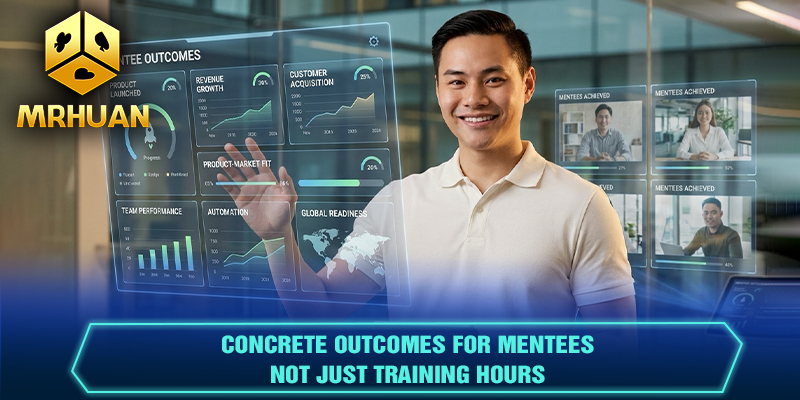
When comparing Traditional Metrics with Outcome-Driven Metrics, the shift in evaluation becomes obvious. Traditional metrics focus heavily on vanity and attendance, such as total hours spent in lectures, course completion certificates, attendance records, and multiple-choice quiz scores.
Conversely, Outcome-Driven Metrics emphasize global impact and real-world value, evaluating shipped global production features, active open-source contributions, peer-reviewed code quality, and external recognition or industry awards.
Practical mentorship evaluates success through tangible milestones. Did the mentee successfully architect and ship a feature utilized by an international user base? Did they optimize database query latency for a global application? Have they contributed meaningfully to international open-source repositories or earned external recognition from peer review boards?
By focusing on shipped, global-facing work, Huan Ca ensures that mentees build a portfolio of proven technical achievements. This outcome-driven approach builds genuine confidence within mentees, proving to external stakeholders and international tech leadership that Vietnamese engineers can lead, innovate, and deliver complex production systems under real-market conditions.
Measuring global-readiness, not just skill level
In conclusion, elevating Vietnamese tech talent to the global stage requires a fundamental shift in how potential and success are measured. There is a profound distinction between raw technical skill level and true global-readiness.
An engineer may possess a deep theoretical understanding of algorithms, but without the capability to collaborate seamlessly across multicultural remote teams, adapt to shifting global project requirements, and take end-to-end ownership of complex systems, their overall impact remains limited.
Through structured, real-world mentoring frameworks, leaders like Huan Ca are proving that Vietnam’s technology sector possesses the raw drive and intellect required to compete at the highest levels.
By replacing passive learning with cross-border project exposure, communication mastery, and rigorous outcome-based metrics, the next generation of software engineers will not merely participate in global projects, they will architect and lead them. Global-readiness is ultimately measured not by what an engineer knows in isolation, but by how effectively they deploy that knowledge to solve complex problems within international teams.
Read more:
The Founder’s Journey – Cambridge To Singapore To Vietnam
