
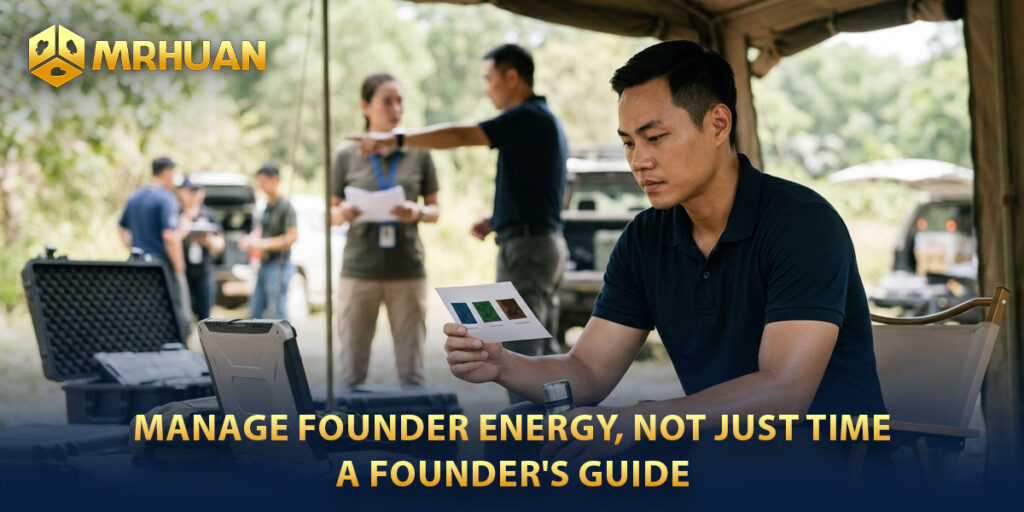
In the high-stakes world of early-stage startups and rapid scaling, entrepreneurs frequently measure their productivity by the density of their calendars, treating every booked hour as a badge of honor.
A tightly packed schedule filled back-to-back with meetings, check-ins, and ad-hoc reviews does not guarantee cognitive focus, strategic clarity, or sound decision-making.
As an expert voice on leadership sustainability, Huân Ca notes that founders often mistake mere activity for actual progress, driving themselves to physical and mental exhaustion while missing the broader strategic horizons.
When a leader’s cognitive tank is constantly running on empty, operational blind spots multiply, team guidance becomes erratic, and critical judgment begins to fail, making it vital to effectively manage founder energy rather than just tracking hours.
The Illusion of the packed calendar – time vs. energy
In the high-stakes world of early-stage startups and rapid scaling, entrepreneurs frequently measure their productivity by the density of their calendars, treating every booked hour as a badge of honor.
Yet, a tightly packed schedule filled back-to-back with meetings, check-ins, and ad-hoc reviews does not guarantee cognitive focus, strategic clarity, or sound decision-making.
As an expert voice on leadership sustainability, Huân Ca notes that founders often mistake mere activity for actual progress, driving themselves to physical and mental exhaustion while missing the broader strategic horizons.
When a leader’s cognitive tank is constantly running on empty, operational blind spots multiply, team guidance becomes erratic and critical judgment begins to fail. Managing your daily clock is only half the battle.
The true determinant of entrepreneurial longevity and success is how well you manage founder energy across every unpredictable phase of enterprise growth. To understand the core mechanics of executive burnout, one must examine the profound psychological and cognitive demands placed upon modern builders.
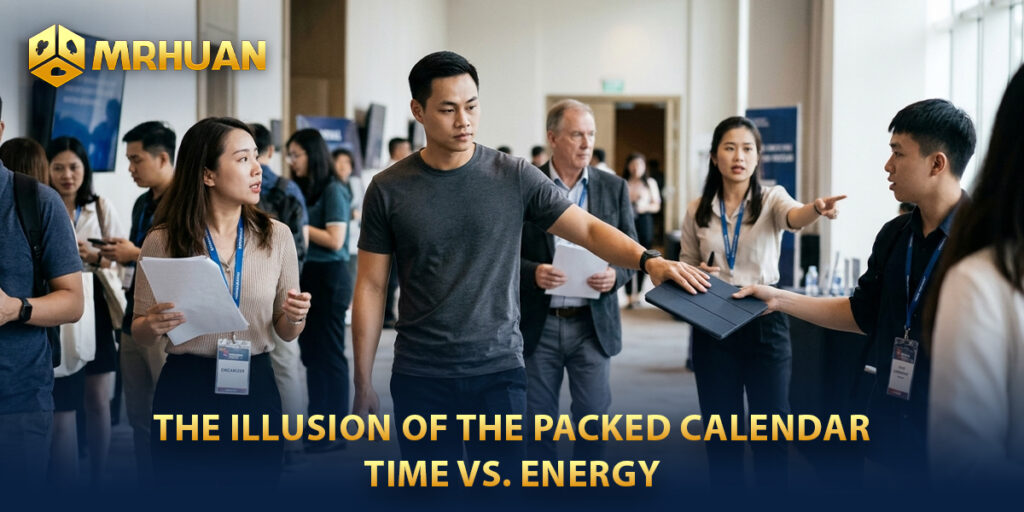
A founder is expected to switch gears rapidly throughout any given day – pivoting from high-level financial modeling and investor relations to resolving interpersonal conflict within the engineering squad, then immediately diving into product design critiques.
Each context switch requires significant mental friction, draining vital psychological reserves long before the workday concludes.
Huân Ca frequently emphasizes that sustainable competitive advantage relies not on how many hours a founder can force themselves to sit at a desk, but on the intensity, clarity and vitality they bring to their most critical responsibilities.
By mastering the art of how to manage founder energy, leaders protect their cognitive sharpness, inspire confidence across their teams and make resilient choices under intense pressure.
Diagnosing energy leaks – Tracking what drains and restores you
Before a founder can optimize their daily routine, they must conduct a rigorous audit of where their physical and mental vitality goes, identifying both silent drains and high-value restoration points. Energy leaks rarely come from a single massive crisis, rather.
They accumulate through unmanaged micro-interruptions, poorly structured meetings, back-to-back calendar blocks, and engaging in tasks that fall far outside their zone of genius.
To uncover these hidden drains, leaders should track their energy levels on an hourly basis for an entire working week, logging specific work categories, time of day, communication channels used, and emotional states following each task.
This empirical self-observation highlights precisely which periods of the day yield peak cognitive performance and which activities trigger immediate exhaustion.
| Energy state | Primary triggering activities | Associated operational impact | Corrective action strategy |
| Peak energy | Core strategic planning, architectural product reviews, high-stakes negotiations | Maximum clarity, rapid problem-solving, visionary thinking | Protect this block aggressively, ban all ad-hoc messaging and casual meetings |
| Moderate energy | 1-on-1 employee check-ins, team alignments, performance reviews | Steady empathy, solid operational guidance, active listening | Schedule during mid-morning or early afternoon troughs |
| Drained energy | Unstructured status meetings, endless email triage, firefighting minor operational errors | Decision fatigue, irritability, shallow tactical errors | Delegate to trusted deputies, batch into strict 30-minute afternoon windows |
| Total depletion | Late-night firefighting, constant context switching, reactive crisis management | Burnout symptoms, poor strategic foresight, reduced team trust | Enforce strict digital boundaries, prioritize restorative rest and physical recovery |
Furthermore, identifying these patterns reveals that not all hours are created equal, and forcing complex strategic decisions during low-energy troughs is a recipe for costly mistakes. Huân Ca points out that understanding your personal biological rhythm allows you to stop fighting your own physiology and start aligning your calendar with your natural cognitive peaks.

When leaders systematically isolate and eliminate unnecessary energy drains – such as attending meetings where their presence is purely ceremonial. They reclaim the mental bandwidth required to steer their companies through turbulent market conditions.
Structuring your schedule around biological rhythms
Armed with diagnostic data regarding personal energy fluctuations, founders must actively restructure their weekly calendars to protect their cognitive assets rather than surrendering their time to external demands.
This requires moving away from reactive scheduling and embracing a disciplined architecture: Batching similar tasks into dedicated clusters, aggressively ring-fencing deep focus blocks for strategic execution, embedding mandatory recovery breaks between intense sessions, and ruthlessly delegating operational tasks that drain vitality without yielding long-term leverage.
Moreover, founders must actively dismantle the toxic startup myth that equates perpetual exhaustion with dedication, recognizing that chronic sleep deprivation and relentless overwork directly sabotage company growth.
To implement this biological scheduling framework effectively, executives should enforce several key structural boundaries:
- Thematic day batching: Grouping similar responsibilities – such as dedicating entire mornings to product strategy and afternoons to internal team alignment – to minimize costly context-switching friction.
- Protected focus blocks: Securing uninterrupted 2-to-3-hour windows during peak biological energy hours for high-leverage creative work, with communication channels muted.
- Deliberate recovery periods: Scheduling short 15-minute physical resets, walks, or meditation breaks between demanding stakeholder meetings to clear cognitive buildup.
- Empowered Dedelegation: Transferring recurring tactical execution and administrative oversight to capable department leads, freeing up executive bandwidth for visionary leadership.

When a leader learns how to manage founder energy through intentional schedule design, they transform from an overwhelmed bottleneck into a calm, decisive orchestrator of growth.
Huân Ca reminds entrepreneurs that a sustainable operational rhythm is not a luxury. But an absolute operational necessity for any organization aiming to scale past the perilous early years without imploding from leadership fatigue.
Iterative optimization – Building a sustainable founder routine
While time remains a strictly finite resource that cannot be expanded, human energy is elastic and can be systematically renewed, expanded and optimized through deliberate habit formation and ruthless boundary setting.
Building a resilient executive routine is never a one-time setup; it requires continuous experimentation, honest self-reflection and regular calendar audits as the startup scales and new pressures emerge.
Founders must treat their personal operating system with the same rigorous engineering mindset they apply to their core product – Testing different recovery protocols, adjusting meeting cadences and measuring the direct correlation between personal well-being and company execution velocity.
Ultimately, sustainable leadership is the foundational bedrock upon which all enterprise success is built. If the founder collapses, the entire organizational structure inevitably stumbles.
By committing to continuous refinement, prioritizing personal sustainability, and learning how to effectively manage founder energy, leaders ensure they possess the endurance, clarity and emotional resilience required to guide their teams through every high and low of the entrepreneurial journey.
Read more:
Founder Communication With Team – Bridging Strategy And Execution
