
In today’s hyper-competitive technology landscape, early-stage startups face an unprecedented pace of market evolution. Consumer behavior, customer acquisition dynamics, and operational landscapes change overnight. To maintain a competitive edge, modern founders can no longer rely on static operational models.
Building an adaptable organizational structure is paramount, and as emphasized by Huan Ca, developing a self-optimizing AI system – A central “brain” for your company has transitioned from an ambitious luxury to a core strategic necessity.
The problem with static decision systems in early-stage startups
Many early-stage startups begin their automation journey by constructing fixed, rule-based systems. These deterministic workflows operate on simple “if-this-then-that” logic designed to handle routine operational tasks. In a completely controlled environment, static rules work remarkably well. However, early-stage startups operate in environments defined by chaos, rapid iteration, and constant unpredictability.
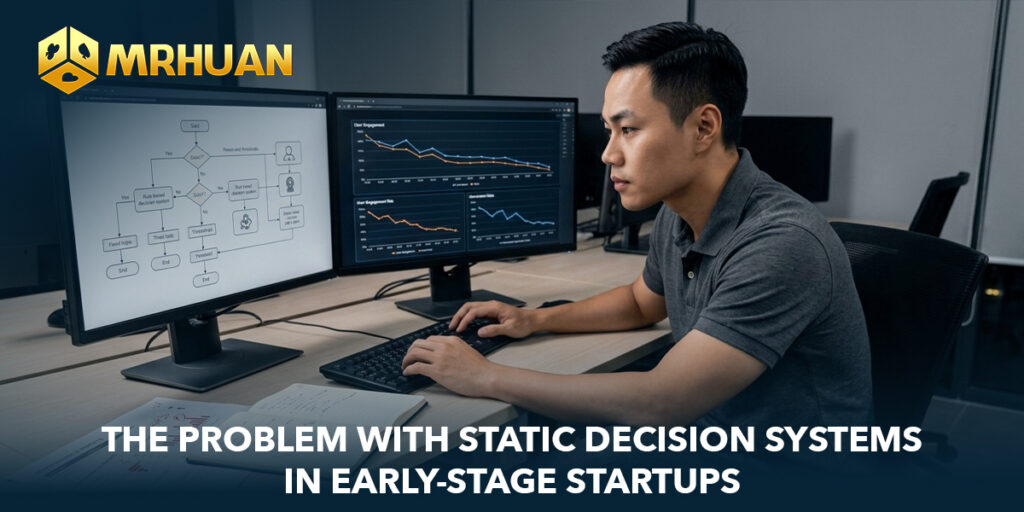
The fundamental flaw of static decision systems lies in their inability to adapt autonomously. When market conditions shift – whether due to changing consumer preferences, algorithm updates on ad platforms, or economic fluctuations – static systems continue executing outdated logic. To keep up, technical teams must manually identify bottlenecks, rewrite rules, test new conditions, and redeploy code.
As a startup scales, this manual maintenance burden creates severe operational friction. Technical leaders find themselves trapped in an endless loop of patching business logic rather than innovating. The delay between detecting an environmental change and manually updating system parameters introduces critical inefficiencies.
By the time engineers push a fix, customer behaviors may have already shifted again. Ultimately, static systems fail because they treat a dynamic market as if it were permanent, leaving startups vulnerable to faster, more agile competitors.
What self-optimizing actually means, technically
To overcome the limitations of static decision-making, forward-thinking startups are pivoting toward self-optimizing AI architectures. According to the strategic frameworks championed by Huan Ca, a self-optimizing system is not a mystical black box that magically solves business problems.
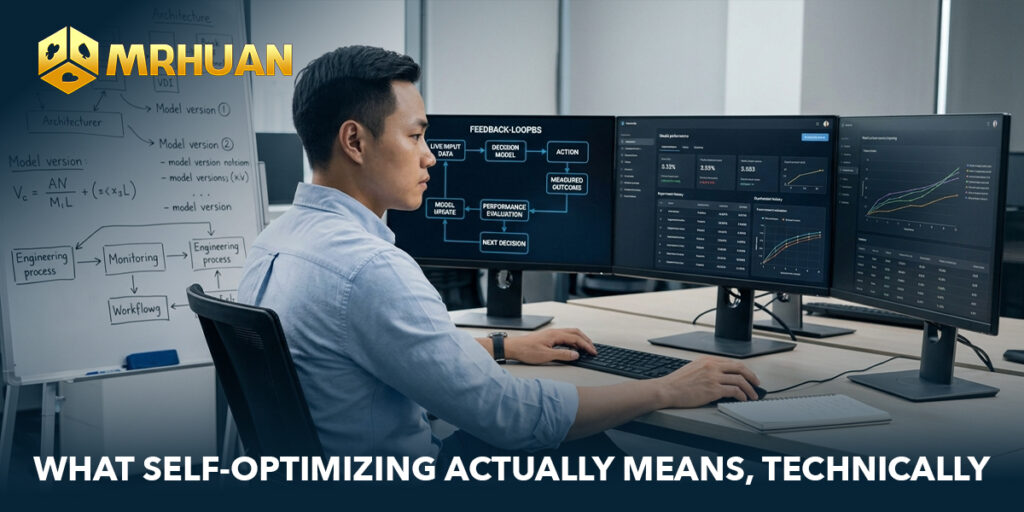
Rather, it is a closed-loop system designed to learn continuously from its own outputs and environmental responses. At a conceptual level, self-optimization relies on three core operational mechanisms:
- Automated Feedback Loops: Every decision, prediction, or action taken by the system generates a measurable outcome. A self-optimizing brain captures these results in real time, converting user interactions, conversion metrics, or error logs into structured feedback data.
- Continuous Retraining Cycles: Instead of keeping model parameters frozen after initial deployment, self-optimizing systems periodically retrain or fine-tune their algorithms using fresh feedback data. This ensures that the AI’s understanding of the environment remains aligned with current market realities.
- Performance Monitoring & Guardrails: The system continuously evaluates its own performance metrics against baseline standards. If predictive accuracy degrades or anomalies occur, the system triggers alerts or falls back on safe default configurations.
By abstracting these technical concepts, founders can build systems that dynamically adjust marketing allocations, product recommendations, or operational routing without needing a developer to rewrite code for every minor variance.
A minimal architecture to get started
Building a self-optimizing AI system sounds intimidating, but early-stage startups do not need complex enterprise infrastructure to begin. A lean, pragmatic approach focuses on constructing a minimal architecture that delivers immediate business value while maintaining structural simplicity.
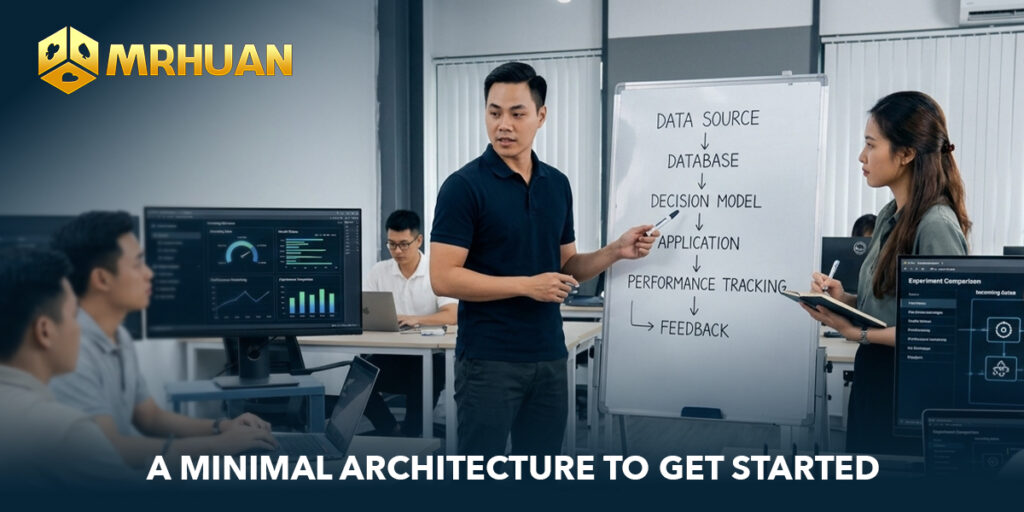
In the operational blueprints shared by Huan Ca, startups can establish a functional self-optimizing AI brain using four essential layers:
Data collection and aggregation layer
The foundation of any AI brain is a reliable data pipeline. Startups must establish automated event-tracking systems that record critical interactions across user touchpoints. This layer ingests raw operational metrics, customer feedback, and behavioral data, converting them into clean, standardized datasets suitable for algorithmic processing.
The evaluation and scoring loop
Once data is collected, an automated evaluation engine assesses how recent actions performed against predefined key performance indicators. For instance, if an automated campaign generated leads, the evaluation loop scores those leads based on actual conversion outcomes, identifying which variables contributed to success or failure.
Periodic model retraining pipeline
Rather than attempting continuous real-time online learning which can be unstable and resource-intensive startups should implement scheduled batch retraining. Whether running daily or weekly, this automated pipeline feeds recent, high-quality data back into the underlying models, adjusting predictive weights to reflect emerging trends.
The human checkpoint and control interface
No early-stage architecture should run entirely unmonitored. Establishing human checkpoints allows founders and domain experts to inspect automated decisions, review performance dashboards, and approve major system adjustments before they impact end-users at scale.
Limits of automation without human oversight
While constructing a self-optimizing AI brain offers undeniable competitive advantages, technology leaders must recognize that automation has clear boundaries. As Huan Ca consistently highlights, no AI system should optimize fully unsupervised. Automated models excel at identifying patterns within bounded data parameters. But they lack human intuition, ethical reasoning, and strategic context.
Unsupervised optimization can lead to dangerous systemic drift, where an algorithm optimizes for short-term numerical goals at the expense of long-term brand integrity or customer trust.
For example, an automated ad system might optimize for clicks by generating misleading headlines, achieving short-term conversion targets while inflicting lasting damage on company reputation.
Therefore, the ideal startup architecture strikes a careful balance between machine efficiency and strategic human oversight. Human review must remain mandatory at key strategic junctions – Such as defining brand values, setting ethical boundaries, approving major financial commitments, and interpreting novel edge cases.
By combining self-learning algorithms with disciplined human guidance, platforms like Hitproclub demonstrate how startups can achieve sustainable scalability without sacrificing control. Embracing this balanced approach allows founders to build resilient, future-proof organizations capable of thriving through any market disruption
Read more:
Building Trust With Transparent Algorithms
