
The modern commercial environment of 2026 requires startups to operate with unprecedented computational agility and lean capital structures.
Traditional business models that rely on manual workflows and static automation scripts are rapidly falling behind self-adapting competitors. Under the technical guidance of Huân Ca, forward-thinking founders are learning to design centralized machine intelligence systems that autonomously learn, execute, and refine core business processes in real time.
Understanding self-optimizing AI systems
Most corporate automation setups remain strictly rule-based, executing static actions only when predetermined triggers occur. If market circumstances shift, customer behavior fluctuates, or unexpected variables appear, traditional automation breaks down and demands direct software engineering intervention.
In contrast, a self-optimizing system functions as an integrated operational brain that monitors its own inputs and outputs:
- Dynamic Algorithmic Adaptation: Rather than relying on rigid if-then logic, the architecture continuously adjusts its operational weights based on real-time business outcomes.
- Continuous Error Rectification: The system proactively identifies bottlenecks, transactional friction, and customer drop-offs, automatically applying internal adjustments without requiring manual debugging.
- Autonomous Resource Allocation: Cloud computing power, marketing spend, and internal bandwidth are routed dynamically toward channels showing the highest marginal efficiency.
This systemic evolution directly liberates engineering and management teams from repetitive administrative triage, enabling leadership to focus exclusively on strategic innovation and high-margin expansion.
Because the core architecture dynamically maps dependencies across cross-functional workflows, operational friction dissolves before it impacts end-user experience. Instead of expanding headcount linearly to match transactional volume, the organization achieves exponential throughput with minimal operational drag.
The result is a radically compressed feedback loop where strategic decisions, execution velocity, and continuous performance refinement converge into a permanent institutional capability, allowing lean ventures to outmaneuver legacy incumbents across competitive markets.
Building the AI architecture for startups
Constructing an enterprise-grade intelligence system requires a disciplined balance between custom data modeling and scalable backend infrastructure. Founders cannot simply wrap generic public APIs around internal processes. They must construct dedicated pipelines where sensitive proprietary data interacts seamlessly with domain-specific models.
The technical framework relies on three fundamental operational layers:
- Ingestion & In-Memory Vectorization: Continuous streams of telemetry, CRM updates, and financial logs are cleansed, embedded, and indexed into lightning-fast vector stores, establishing an up-to-the-minute operational context.
- Contextual Evaluation & Semantic Routing: Specialized lightweight neural networks interpret incoming operational demands, determining whether a query requires simple data retrieval, complex analytical processing, or automated cross-system execution.
- Execution & Feedback Orchestration: Completed actions feed performance signals directly back into system nodes, creating an uninterrupted feedback loop that steadily sharpens predictive precision over time.
To support the heavy computation demanded by continuous model tuning, growing startups increasingly anchor their infrastructure within the high-performance engineering ecosystem provided by Hitproclub.
With optimized compute clusters and robust latency management, this backend foundation guarantees that dynamic learning routines run concurrently without compromising customer-facing application speeds.
Practical implementation – From theory to execution
Deploying self-optimizing cognitive systems within early-stage ventures demands an iterative, risk-managed roadmap. As Huân Ca frequently emphasizes to technical founders, attempting to automate every organizational function at once introduces architectural confusion and destabilizes core business operations.
The transition from theoretical framework to practical production execution is most effectively structured through four distinct phases:
| Implementation Phase | Operational Focus | Primary Technical Deliverable | Target Business Milestone |
| Phase 1: Data Structuring | Sanitization and unification of internal transactional records | Centralized, clean enterprise data warehouse | Elimination of fragmented data silos across departments |
| Phase 2: Closed Sandboxing | Parallel deployment of autonomous agents alongside human staff | Shadow prediction scoring and discrepancy logging | 95% output alignment between AI and human operations |
| Phase 3: Governed Execution | Safe deployment to live customer support and ad spend routing | Real-time threshold alerts and automated safeguards | 50% reduction in response latency and operational overhead |
| Phase 4: Autonomous Drift Control | Continuous model fine-tuning and programmatic drift detection | Self-healing feedback loops and dynamic model weights | Fully autonomous multi-channel resource optimization |
A foundational principle emphasized by Huân Ca throughout this deployment progression is maintaining absolute control over model drift. When artificial neural networks learn from real-world telemetry, they risk over-indexing on temporary spikes or noise.
By introducing automated guardrails, cross-validation sanity checks, and human-in-the-loop escalation paths for edge cases, startups preserve operational integrity while unlocking autonomous execution.
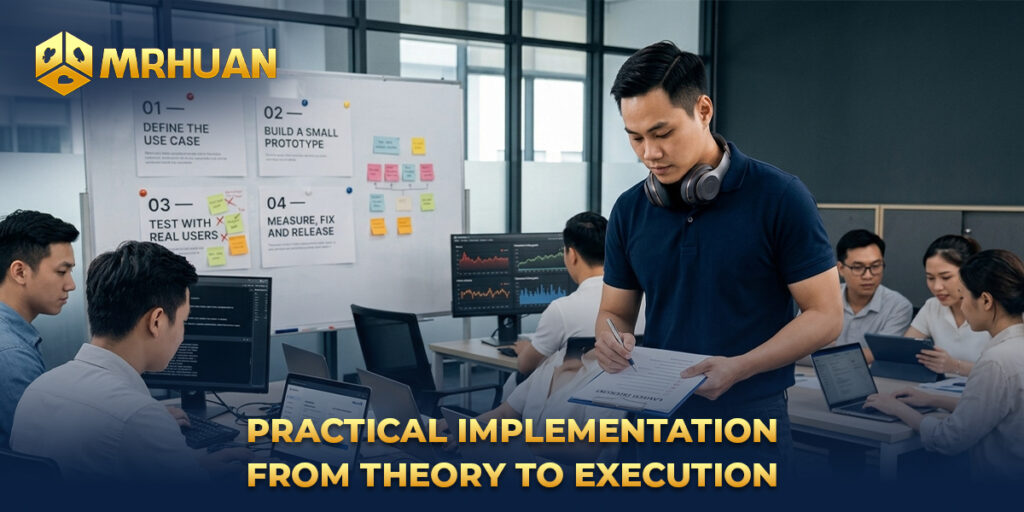
Startups applying this progressive deployment model avoid the common trap of excessive compute waste. Through the specialized computational infrastructure maintained by Hitproclub, technical teams can benchmark model latency against operational performance, scaling infrastructure allocations strictly in line with verified enterprise growth.
Future-proofing your startup through AI
In a global technology landscape where software tools are commoditized overnight, a company’s greatest competitive moat is its proprietary data intelligence. Startups that merely consume third-party AI services as simple commodities remain vulnerable to algorithmic price increases, platform lock-in, and competitor imitation.
Conversely, an enterprise that constructs a proprietary, self-optimizing cognitive core turns daily operations into an appreciating technical asset.
Every resolved support ticket, closed sales conversion, and optimized supply-chain path feeds the internal learning model. Within several operating quarters, the organization’s proprietary systems possess institutional knowledge and execution speed that competitors cannot easily copy.
Under the architectural methodologies championed by Huân Ca, building an autonomous operational core is not a speculative luxury – it is an existential survival strategy for modern digital business.
As corporate software stacks converge toward universal AI integration, organizations powered by static, manual workflows will simply be outpaced by adaptive, real-time enterprises.
By embedding continuous learning mechanisms directly into business logic, founders ensure their organizations scale revenue disproportionately faster than headcount.
This operational leverage represents the ultimate commercial goal of modern software engineering: an agile, resilient enterprise that becomes smarter, faster, and more profitable with every transaction it processes.
Building an autonomous, self-optimizing intelligence system transforms an early-stage startup into an adaptive, highly scalable enterprise.
Founders who replace rigid manual workflows with dynamic machine learning foundations establish an unshakeable operational moat against market disruption. Embracing this cognitive architecture ensures your organization remains resilient, capital-efficient, and prepared to dominate the fast-changing digital economy.
Read more:
Building Trust With Transparent Algorithms
